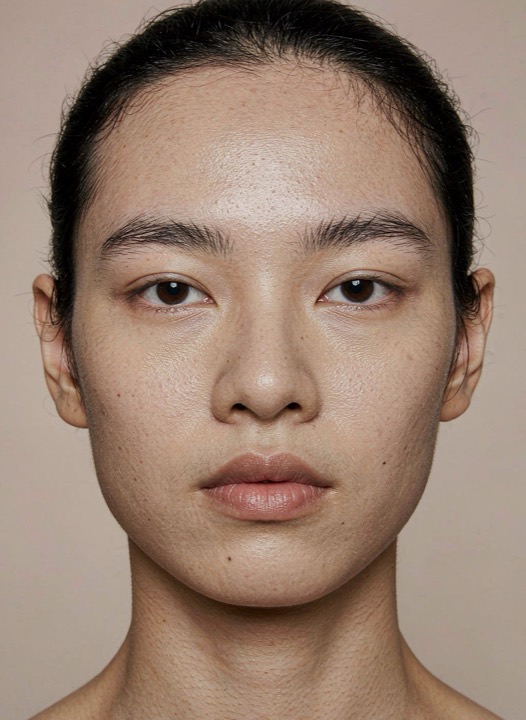
A face is a set of measurements, not a verdict.
One front-facing photograph. 478 landmarks read on your device. Four geometric readings and a score out of eight, in a few seconds.
The number describes this photograph under this light, from this angle. It is not a ranking of people, and it is not advice. Take another photo and the readings move a little — that is expected.
Illustrative sample — the four frames show one synthetic portrait in four states.
The free score runs entirely in this browser from 478 facial landmarks. No account, no email, and no photo leaves your device.
Four readings, one number
Each reading comes from fixed geometry on the landmark mesh. We show the parts next to the total so you can see which ones are stable and which ones depend on the photograph.
| Measure | What it looks at | Sample A |
|---|---|---|
| Symmetry | Left–right agreement of paired landmarks around the facial midline. Reported as a deviation, not a judgement. Paired points around the eyes, brows and jaw are compared against a midline fitted to the face itself. | 82 |
| Proportion | Spacing between the eye line, nose base, mouth and chin. Measured as ratios rather than absolute distances, so a photo taken closer to the camera does not inflate the reading. | 76 |
| Balance | How upper, mid and lower face agree with each other. Compares the three horizontal bands of the face. A tilt of the head or a crop that cuts the chin moves this reading more than the others. | 71 |
| Harmony | How the four features read together as a whole. A composite of the first three measures, weighted so that one unusual feature cannot dominate the total on its own. | 68 |
A single total hides more than it reveals. Two people can arrive at the same score for completely different reasons: one with strong symmetry and weaker proportion, another with the reverse. Showing the four measures next to the total makes that difference visible, and it also makes the result easier to sanity-check. If one measure looks odd, the usual cause is the photograph — a tilted head, a shadow across one cheek, or a crop that cuts the chin.
The values in the Sample A column are illustrative preview readings, not a score for you. Your own result is computed from your own photograph inside your browser and is never one of these preset values. The measures themselves are fixed geometry, not a model that drifts between updates, so the same photograph returns the same numbers every time you run it.
We are deliberately modest about what this can do. The numbers describe relationships between landmarks in one photograph under the lighting and angle of that shot. They are entertainment and self-reference, not a scientific measurement of attractiveness and not a statement about anyone’s worth. Read the breakdown, compare a couple of photos taken in similar light, and take the result for what it is: a consistent second opinion from a simple set of rules.
Your photo stays yours
Privacy is the reason the free tool works the way it does, not a feature bolted on afterwards.
Zero bytes sent
The model and the geometry run in this browser. There is no upload step in the free score.
Nothing to delete
No account and no history. Close the tab and the photograph is gone.
Repeatable numbers
Fixed formulas, so the same photograph gives the same readings after a reload.
A face is among the most identifiable things you can put into a web form, and a curiosity tool is a poor reason to hand one to a server. Running the landmark model locally costs a few seconds of device time and removes the entire category of risk: there is no upload endpoint to protect, no bucket to misconfigure and no retention policy to trust. If you later choose the written report, that is a separate, explicit one-time action with its own disclosure.
Two sample reports
Illustrative examples from synthetic portraits. They show the shape of the reading, not a claim about any real person. Click one to load it into the four frames at the top of this page.
Both pictures on this page are generated portraits, not real people. In the booth strip above, all four frames show the same portrait under the same crop — only the overlay changes: an untouched original, a verdict stamp, a landmark mesh and an eye-area outline. That consistency is deliberate. A measurement you cannot line up with the face it came from is not a measurement you can trust, so we keep the face in exactly the same position in every frame and draw the overlays from the landmarks found on that face.
Questions
Is it free?
The score and its four-measure breakdown are free, with no signup, no email and no account. A written report with more depth is available as a one-time purchase if you want it. There is no subscription and no recurring charge.
Does my photo get uploaded?
No. The free score is computed on your device with an on-device landmark model. The photograph stays in the browser tab for the free tool, and no image is sent to a server, stored in a database or written to a log.
Is the mesh on the photo real?
Yes. Every dot and line in the Symmetry frame is drawn from the 478 landmarks actually measured on that photograph, mapped through the same crop the frame applies. It is not a decorative illustration. When you use your own photo, the mesh is redrawn from the landmarks found on your face.
Why do other sites give me a different number?
Different tools use different models, different scales and different landmarks. A 6.4 on a 0–8 geometric scale is not comparable to a percentage or a ten-point rating from another method. Only compare scores produced by the same method, and treat the number as entertainment rather than a verdict.
Can I get the same score twice?
Yes, if the photo and the crop stay the same. The measures are fixed geometry rather than a model that drifts between updates, so the same image returns the same numbers. Change the angle, the light or the expression and the measurements will move — that is expected.
Explore by question
Short explainers for the searches that bring most people here, each with the free tool on the page.
Why we show the breakdown
A number without its ingredients is very easy to over-read.
A score is a summary of a photo, not a summary of a person. It reflects how a fixed set of measurements lands on one image taken under one set of conditions. Move the camera a little, change the light, or change your expression and the numbers will move too. That variability is normal, and it is exactly why the breakdown is shown next to the total: the individual metrics tell you which part of the result is stable and which part is sensitive to the photo.
Reading a result honestly
Repeat the photo, not the verdict.
If you want a result you can trust, take two or three photos on different days in similar light and compare them. A pattern that repeats across photos means something; a single number from a single take does not. Use the free tool as often as you like — there is no account, no daily limit, and no photo leaves your device. We also update these tools occasionally as the underlying geometry library improves, so if a number changes between visits, the most common cause is still a different photo or a different crop rather than a change in the formula.
The tool is intentionally narrow. It does not rank people against each other, it does not accept votes or comments, and it does not offer a plan to change how you look. It answers one small question — how a handful of geometric relationships in this one photograph line up — and then gets out of the way.